example.com
Verify you are human by completing the action below.
example.com needs to review the security of your connection before
proceeding.

Before we can let you through to example.com, please complete the following steps:
The post 2021 will be an important year for the issuance of the digital dollar appeared first on We Greece.
]]>The assurance that a broad public debate will take place on the issuance of the digital dollar by the US Federal Reserve was given by the head of the Federal Reserve Jerome Powell, during the second day of his congressional hearing on Wednesday, February 24, 2021.
Whenever an elected official in Congress asks US Federal Reserve Chairman Jerome Powell about the issue of the digital dollar, the response he receives emphasizes the attention to be paid to this important monetary innovation and the risk inherent in stability of the US financial system, commented in a post by coindesk.com.
At the same time, he pointed out in a Reuters report, he pointed out that they will need special approval from Congress as the mandate or mandate of the Central Bank, which includes control over the circulation of the currency, which is the main instrument for the conduct of monetary policy.
However, Powell went further than any of his predecessors during his hearing in the Senate Finance Committee, noting that the US Federal Reserve will be “engaged in a dialogue with the public” about the digital dollar in 2021, giving for the first time times a schedule for the central bank digital currency issue plan.
“This is going to be an important year,” Powell said of the digital dollar project.
“This will be the year we work with the public quite actively, including some of the public consultations we are planning.”
Powell stressed that the Fed will not make decisions and then present them to the public, but will talk to the Americans about the consequences of the adoption of the digital dollar in the payment system and elsewhere.
“There are both policy and technical issues that raise very important questions,” Powell said.
“We will have a public debate; in the meantime we are working to address the technical challenges, and we are sharing our concerns with the rest of the central banks around the world,” he said.
He concluded that the central bank will be careful to design the digital dollar in a way that will not “undermine υγι the healthy functioning of the market”
The post 2021 will be an important year for the issuance of the digital dollar appeared first on We Greece.
]]>The post One of the world’s top banks issues bonds that can be bought with Bitcoin appeared first on We Greece.
]]>One of the “Big Four” banks in the People’s Republic of China, CCB is ranked the second-largest bank worldwide by total assets as of fall 2020.
The megabank’s plan with the new blockchain-based debt issuance is to raise up to $3 billion in total, starting with a tranche of $58 million, from individuals and institutions. The digital bonds will be issued through an offshore branch of CCB in Labuan, Malaysia, at a minimum of as little as $100 each, and will have a tenor of three months. They pay an annualized interest of Libor plus 50 basis points, or roughly 0.75%.
The innovation is that these bonds are being used as tokenized certificates of deposit on the blockchain, which supports the issuance of such small-sum bonds; non-blockchain-based bonds are typically sold at higher minimums, and are therefore limited to professional investors or other banks.
Moreover, the tokenized certificates of deposit will be tradable on the Fusang exchange. The exchange, which is regulated in Labuan, will launch live trading of the bonds on Nov. 13. Notably, as Fusang supports cryptocurrency trading, traders will be able to exchange Bitcoin (BTC) for U.S. dollars in order to purchase the bonds. The transactions will be charged at a commission.
Fusang’s CEO Henry Chong has told reporters that if the bonds are popular, the digital exchange intends to initiate similar products denominated in other currencies. The bonds’ 0.75% annualized interest is higher than most U.S. dollar bank-deposit rates, as the Wall Street Journal has emphasized.
Tax residents of the United States and China, as well as entities or persons in Iran and North Korea, will not be able to purchase the digital security. All proceeds from the issuance will be deposited at the CCB’s offshore Labuan branch. Labuan is a small island described by the Wall Street Journal as a tax haven.
CCB is “not dealing in bitcoin or cryptocurrencies,” but rather “taking bank deposits, which is our core business,” CCB Malaysia’s chief operating officer Steven Wong stressed. The offering is nonetheless being heralded as a big innovation. This is “the first publicly listed debt security on a blockchain,” said Felix Feng Qi, the CEO of CCB’s offshore Malaysian business and principal officer of the CCB Labuan branch.
The post One of the world’s top banks issues bonds that can be bought with Bitcoin appeared first on We Greece.
]]>The post Tesla gets progressive with Bitcoin ATMs at factories, claims report appeared first on We Greece.
]]>Tesla, being as forward-thinking as ever, now has Bitcoin ATMs at the Fremont Factory and Gigafactory Nevada.
One of the Bitcoin ATMs was originally spotted by Twitter user Will Reeves. LibertyX, the company responsible for the Bitcoin ATMs, reached out to Finbold and confirmed Reeves’ sighting in an official statement.
“The Tesla locations have been live since August. The ATM is currently only accessible for employees,” LibertyX told Finbold.
The Bitcoin ATM company also stated that it did not install a new kiosk at Gigafactory Nevada. It simply added Bitcoin-selling features via software to three ATMs in the facility that were already installed.
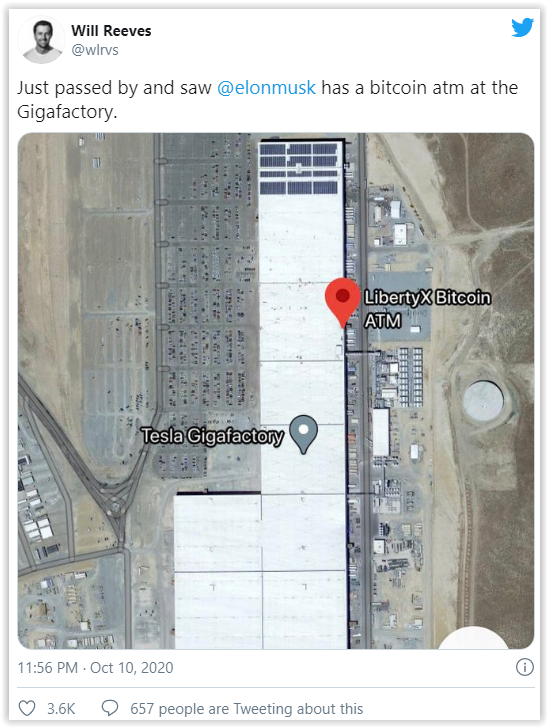
A quick search through LibertyX’s website revealed that Tesla also has a Bitcoin ATM in the Fremont Factory for employees to use.
Avid Tesla supporters know the intriguing relationship Elon Musk has with cryptocurrencies and crypto scammers.
Just this past June, crypto scammers used Elon Musk and SpaceX to steal up to $150,000 from YouTube viewers. The scammers convinced viewers to send Bitcoin to several YouTube channels by hacking legitimate accounts and rebranding them to fit their purpose.
They used archived footage of Elon Musk to broadcast a live event and convince viewers the channels were authentic. Other scammers went a step further and copied Elon Musk’s Twitter account, confusing his followers.

Despite crypto scammers using his identity and his companies’ brands for their schemes, Elon Musk remains a supporter of cryptocurrencies and an influential figure in the crypto industry, according to Cointelegraph.
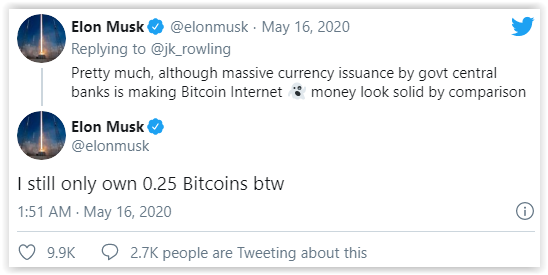
He has applauded Bitcoin, in particular, for having a “brilliant” structure. The installation of two Bitcoin ATMs in two Tesla Gigafactories suggests that Musk’s stance on cryptocurrencies still holds.
The Tesla CEO might not stop at installing Bitcoin ATMs in just two Gigafactories either. LibertyX stated that it has more Bitcoin ATMs ready for installation.
“LibertyX has partnered with the two largest ATM manufacturers (Genmega and Hyosung) to offer bitcoin software preinstalled on traditional ATMs. Once operators activate the feature, consumers can start buying bitcoin with their debit card from ATMs nationwide. We have 5,000 ATMs already live and plan to roll it out at over 100,000 ATMs over the next few years,” the company explained further.
LibertyX did not state that more of its Bitcoin ATMs would be installed at Tesla’s factories. However, it is a possibility, especially if the Bitcoin ATMs in Nevada and Fremont are popular with the employees.
If the Bitcoin ATMs do become a hit, Elon Musk may start thinking of installing Dogecoin ATMs as well. After all, Musk was briefly the CEO of Dogecoin, and the cryptocurrency’s meme origins fit perfectly with his online tendencies.
Source: https://www.teslarati.com/tesla-elon-musk-bitcoin-atm/
The post Tesla gets progressive with Bitcoin ATMs at factories, claims report appeared first on We Greece.
]]>The post Data encryption a threat to fighting child sexual abuse, says DOJ appeared first on We Greece.
]]>In an Oct. 11 statement from the DoJ, the agency called on technology companies to work with the government to find a solution for strong data encryption with the means to allow the investigation of illegal activity and content. The department stated end-to-end encryption that hindered law enforcement from accessing certain content creates “severe risks to public safety.”
The statement was signed by the DoJ, the Home Department of the United Kingdom, the Australian Minister for Home Affairs, India, Japan, a New Zealand Member of Parliament and the Minister of Public Safety and Emergency Preparedness of Canada.
In particular, the DoJ stated such encryption — in which only the senders and receivers can access the data being sent — undermined law enforcement from “investigating serious crimes” and “protecting national security.” In addition, a tech company’s ability to identify and respond to child sexual exploitation and abuse, violent crime, and terrorist propaganda may be compromised, claimed the department.
Citing a 2019 report from the National Center for Missing and Exploited Children (NCMEC), the government agency implied end-to-end encryption needed to be implemented with a solution to safeguard children, or it would undermine the current system of reporting such exploitation.
“In 2018, Facebook Messenger was responsible for nearly 12 million of the 18.4 million worldwide reports of CSAM [child sexual abuse material to the NCMEC],” the DoJ said, citing a 2019 statement from the WePROTECT Global Alliance. “These reports risk disappearing if end-to-end encryption is implemented by default, since current tools used to detect CSAM do not work in end-to-end encrypted environments.”
Elected officials in the United States have already acted to seek a legislative solution to investigating the illicit activities to which the DoJ referred.
In June, three Republican senators put forth a bill that would outlaw end-to-end encryption for technology companies, requiring device manufacturers and service providers to assist law enforcement by providing access to encrypted data. The bill, named The Lawful Access to Encrypted Data Act, is currently under review in the Committee on the Judiciary. There is also the EARN IT Act, a proposed bill that would require digital messages to first pass through government-approved scanning software in order to monitor for malicious criminal activity.
Proponents of both bills have claimed their purpose would include protecting children from sexual abuse. However, many privacy advocates have heavily criticized the bills’ sponsors for what they perceive as the government encroaching on personal freedoms.
Though its statement focused on end-to-end encryption, the DoJ stated it would extend its efforts to “device encryption, custom encrypted applications and encryption across integrated platforms.” The government agency claimed it would hold a “respect for privacy” at the forefront of any legal framework.
“We challenge the assertion that public safety cannot be protected without compromising privacy or cyber security,” the DoJ stated.
Source: https://cointelegraph.com/news/data-encryption-a-threat-to-fighting-child-sexual-abuse-says-doj
The post Data encryption a threat to fighting child sexual abuse, says DOJ appeared first on We Greece.
]]>The post Naming and cryptos appeared first on We Greece.
]]>With sponsorships that offer valuable financial “breath” to the teams and “support” their budgets, in a difficult time for their income in the midst of a pandemic and the consolation is that the companies interested in promoting themselves through the Greek (basketball) market multiply.
Several OEMs make deals – in the model of the Italians, “fashion” that began in previous decades – and in this year’s Basket League 6 championship – from 12 – go to the first jambol with a sponsor in their name!
A jambol that comes a week late, due to the well-known problems they faced as “more than five” 2 of the 12 teams of A1, the Ionian Hellenic Coin and Messolonghi BAXI. After “running” for a few days, the Nikaians managed to present a complete file to the Professional Sports Committee to secure the necessary certificate of participation in the Greek basketball championship, something that happened to the newly enlightened Messolonghi. Any shortcomings were covered, the licenses were given by the EEC and all is well… And let’s go to the “roast”!
The 3 “old” of these 6 sponsors are: OPAP, the far leading brand of the Basket League (and the Euroleague) in its 5th consecutive year of cooperation with the 6-time European trophy winner and 39-time Greek champion Panathinaikos (as Megas Sponsor with PAME STIHIMA on the jersey) and 3rd in a row as a naming sponsor, H Hotels with the Colossus of Rhodes and Megabolt with Lavrio.
The 3 new “players”? Hellenic Coin with Ionikos of Nice, the historical team that highlighted the huge Panagiotis Giannakis and the Bread Factory chain with Larissa.
“Behind” the absolute leader of the gambling market and the largest “blood donor” of Greek sports (Panathinaikos OPAP), follows, sectors such as fintech and a cryptocurrency company (Ionian Hellenic Coin), a chain of bakeries / confectioneries (Larissa Bread Factory), a strong hotel brand (Colossus H Hotels), a company with 40 years of specialization in screws and support systems, from drills, wood screws, cement screws etc. to shipping products (Lavrio Megabolt) and a water and heating company (Messolongi BAXI / former Charilaos Trikoupis)! Last year Peristeri also had Winmasters in its σή brand
Who are the 3 new sponsors of the A1 teams?
THE 3 NEW DEALS IN A1 OF GREEK BASKETBALL
In Ionikos, the position of the network of Affidea diagnostic centers in the name of the association was taken by Hellenic Coin, which was created in 2015 and manages the first Greek cryptocurrency.

In Larissa, the “companion” of the team becomes the Bread Factory (creation of the former volleyball player Ilias Petropoulos), which started in 2016 and since then is constantly expanding in products, as the “multi-space bread” in Holargos offers wine cellar, grocery, meats, meats, meats , as well as coffee, food. In the capital of Thessaly makes its first opening outside Attica, with its 7th store…
As for the new member of the “list”, Hydromarin SA is a company that has been active in the Greek market since 2002 and belongs to the Cherbros Group.
It holds a leading position in the field of water supply and heating, having complete solutions in a nationwide network of 1200 specialized stores with full technical support and is the exclusive representative of VAHI products, the largest European gas boiler factory.
With this brand, he will appear on the jersey of the newly enlightened Mesolongi BAXI or former Charilaos Trikoupis, a name with which he won the title of champion in A2 and from this year he will play in A1!
Michalis Kosmetatos- THE OBJECTIVE.GR
Source: https://www.theobjective.gr/2020/10/23/%CE%BA%CF%81%CF%85%CF%80%CF%84%CE%BF%CE%BD%CE%BF%CE%BC%CE%AF%CF%83%CE%BC%CE%B1%CF%84%CE%B1-%CF%86%CE%BF%CF%8D%CF%81%CE%BD%CE%BF%CE%B9-%CE%BE%CE%B5%CE%BD%CE%BF%CE%B4%CE%BF%CF%87%CE%B5%CE%AF%CE%B1/?fbclid=IwAR3LpY2VrSklZkETw94v_k2wrYYUnUWSpuErzMj1AeK66qM4I88m
The post Naming and cryptos appeared first on We Greece.
]]>The post ARE CRYPTO AND BLOCKCHAIN KEY TO A TECH RENAISSANCE? appeared first on We Greece.
]]>
A former director of the US Mint thinks that the market will gravitate toward these solutions
A panel discussion at COSM explored the future of crypto currencies like Bitcoin and blockchain technologies in general. What might they mean for global money, global security, and internet architecture?
The panel, moderated by Wired contributing editor Spencer Reiss, comprised futurist George Gilder, Steve Forbes, Chairman and Editor-in-Chief of Forbes Media, Ed Moy, former Director of the U.S. Mint, and William Dembski, mathematician, entrepreneur, and philosopher:
Here are some snatches from the dialogue (aired September 11, 2020):
George Gilder (on what’s wrong with the internet):
“It’s a broken paradigm. How do you tell a broken paradigm? The more money you spend on it, the worse it gets. Last year, we had a billion breaches of private data. This year, we’re spending roughly 20-30% more on internet security and we’re on track for three billion breaches. To have IP addresses is like having public keys with no private keys. It’s a failed foundation for a secure system. And we have a solution in the new cryptographic inventions that blockchain epitomizes.”
Steve Forbes (on the challenge of disruptive technologies in general, citing his industry as an example):
“When we started our electronic publishing in the mid-90s, most publishers thought you just took a printed page and put it on line. And that was electronic publishing. That was like, when Edison and others invented film 120 years ago. Some people thought that a fature film was like filming a stage play. No. Very different medium. One of the first things we did was separate Forbes.com from Forbes Magazine. Separate staff, separate buildings, separate support systems. We wanted the baby away from the rollover of the mother. The other thing we did was, we went beyond the content of Forbes Magazine. We used a lot of outside content. We didn’t restrict ourselves to what appeared in Forbes Magazine.”
(Later, Forbes tried combining the two operations but found it extremely difficult. Steve Forbes “It’s amazing how difficult it is to combine two different cultures.”)
Steve Forbes: “One of the things about these kinds of transitions is that there is no play book, no formula, no painting by the numbers… when a disruptive technology comes along, what do you do? You don’t know what to do. You are experimenting constantly.”
Ed Moy (on how cryptocurrency and blockchain could become part of everyday transactions):
“First of all, I hope government doesn’t lead it because we will all be in trouble then. When you look at fiat currency, fiat currency is in essence the government’s monopoly on money and I’m not familiar with that many monopolists who are willing to voluntarily give up their monopolist position. And so government has a vested interest in keeping the system the way it is. The reason I went from an “old money” guy to the future of where I think money can go is that this is a private sector alternative to government’s monopoly. I don’t ever see this as a complete substitution where governments give up their monopoly… but I do think that the market will gravitate toward these solutions.
Further: Chair of Forbes Media says money is about trust. Experts forecast the future of money in general at COSM. Will money be “real” in an information society? Now that Facebook is proposing Libra, a cryptocurrency, this might be a good time to ask.”
Jay Richards’s interview with William Dembski at COSM (aired June 26, 2020) asking,
“Is it possible to create a decentralized, information-based currency?” Dembski offers a thought experiment: “Can you, as a lone individual, create currency that is going to then be created by the individual, but will have legitimacy? That will have intrinsic value rather than depending on some sort of fiat authority trust. And so that was the thought experiment. And it uses some insights from Bitcoin, but I think it goes much further. So I need a blockchain, I need a computation to be scarce. And when I get those certain minimal assumptions, I need to have hashing where you’ve got these one way functions that really mix things up. And if I’ve got public key cryptography, it seems I can get a system that’s very minimal infrastructure. I just need a blockchain that keeps the blocks in an order. No backdating. That’s the problem…”
Πηγή: https://mindmatters.ai/2020/10/are-crypto-and-blockchain-key-to-a-tech-renaissance/
The post ARE CRYPTO AND BLOCKCHAIN KEY TO A TECH RENAISSANCE? appeared first on We Greece.
]]>The post The US is number one…in blockchain patents appeared first on We Greece.
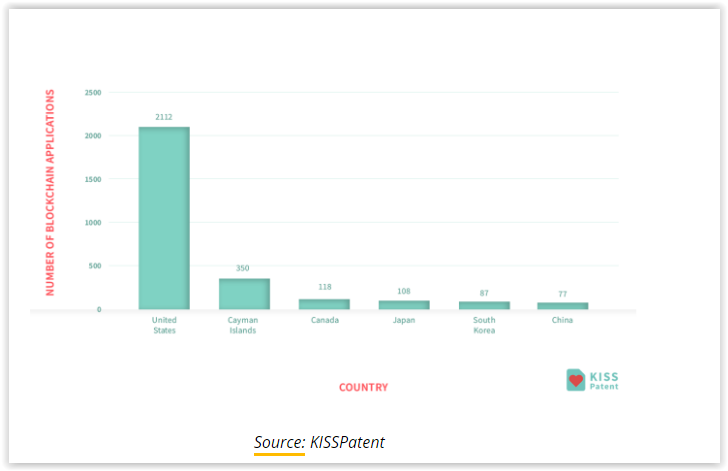
]]>Despite Chinese firm Alibaba filing the most patents so far this year, the United States still takes the lead as the country with the most blockchain patents, a Sept. 17 report from intellectual property consultancy KISSPatent said.
IBM and Alibaba hold the most blockchain patents. Alibaba has filed more than 200 patents while IBM filed a little over 100. But other U.S.-based companies like Bank of America and Mastercard have also filed several patent applications bumping up the total for the U.S. According to KISSPatent, more blockchain patents have been filed in the first half of 2020 than all of 2019.
The U.S. has 2,112 patents, followed by the Cayman Islands with 350 filings and Canada with 118. The rest of the top six are Japan with 108, South Korea with 87 and China with 77 patents. The Cayman Islands is second as Alibaba’s subsidiaries headquartered in the British Overseas Territory filed these applications.
Although Chinese companies are often represented in various top 10 blockchain patent lists, not all of the companies work solely on blockchain. KISSPatent says these companies have blockchain applications as part of their technology portfolio. The reason China filed so many patents, the report said, was to avoid some trading sanctions overseas. It explained that:
“They’ve learned from the example of Xiaomi, the “Chinese Apple,” which was blocked from selling its smartphones in its foray out of China – because the Swedish Ericsson held so many patents.”
The most popular category of patent filing, representing half of all patents, is fintech applications. These include applications using cryptocurrencies and those supporting the storage or the exchange of cryptocurrencies. Other popular categories are patents for decentralized business platforms, solutions deployed over blockchain, business services with a financial component and healthcare and traditional banking services on a blockchain.
Many industry players have expressed concern over patent trolling, so Square helped launch the Cryptocurrency Open Patent Alliance. The group wants to democratize access to innovative technologies.
Source: https://cointelegraph.com/news/the-us-is-number-onein-blockchain-patents
The post The US is number one…in blockchain patents appeared first on We Greece.
]]>The post Beijing ranks first among blockchain cities in China appeared first on We Greece.
]]>The Chinese Blockchain Innovation rankings were revealed at the China International Fair for Trade in Services Summit. The rankings comprehensively evaluates the blockchain technology and development of 83 Chinese cities and special zones, except Hong Kong, Macao and Taiwan. There were four key dimensions considered, such as research and development, industrial development, public popularity, and policy based on multi-source objective data.
According to reports, China’s blockchain regions have obvious advantages in the development of leading cities, with Beijing, Shenzhen, Shanghai, Hangzhou and Guangzhou ranked in the top five.
Beijing came first with a score of 99.82 and Shenzhen came out second with a 91.2 ranking score. It’s worth noting that Shenzhen has more than 5,000 blockchain related firms, making Beijing ranking an important feat.
Following Shenzhen in the ranking is China’s biggest city and one of East Asia’s largest business capital—Shanghai—with a ranking score of 88.
Beijing Fair, the host of the China International Fair for Trade in Services Summit, acknowledged Beijing and Shanghai for making use of their “advantages in research and development (R&D) activities, industrial development and public enthusiasm” to promote and create stronger blockchain awareness to the general public.
In July 2020, the municipal government of Beijing revealed a 20-point plan to improve blockchain. This plan was aimed at increasing the rate at which distributed ledger technologies (DLT) are deployed and developed. This move made the city become more of a blockchain hub, both nationally and globally.
The Beijing Blockchain Innovation Development Action Plan 2020-2022 lists out the plans from the blockchain city to promote its global leading status. By the end of 2021, Beijing plans to be in the forefront of public DLT deployment and blockchain innovation.
Source: https://coingeek.com/beijing-ranks-first-among-blockchain-cities-in-china/
The post Beijing ranks first among blockchain cities in China appeared first on We Greece.
]]>The post New EU Rules To Institute Crypto For Cross-Border Payments By 2024 appeared first on We Greece.
]]>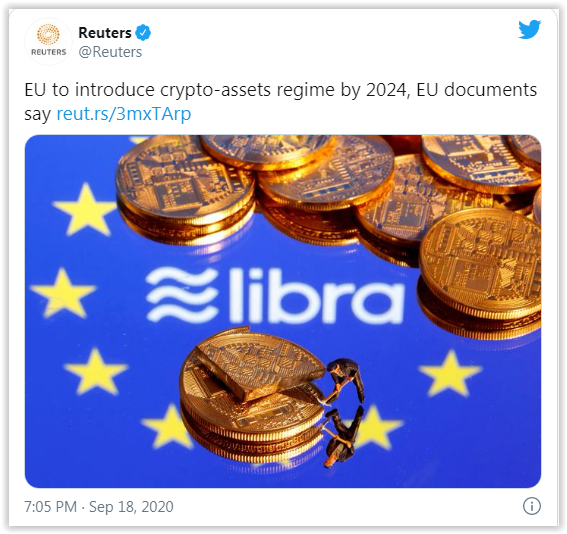
According to Reuters, the European Commission is especially keen to press ahead with crypto adoption because the pandemic lockdowns exposed a failure point in the existing cash-dominated order. To this end, the EC believes that switching to instant payments is now a priority.
In order to achieve this, according to the Reuters report, the EC will put forward draft legislation that will provide a comprehensive regulatory framework for distributed ledger technology (DLT). The proposed legislation will also plug crypto’s regulatory gaps in E.U. law where they may exist.
An excerpt from the document quoted by Reuters reads:
“By 2024, the E.U. should put in place a comprehensive framework enabling the uptake of distributed ledger technology and crypto assets in the financial sector. It should also address the risks associated with these technologies. By 2024, the principle of passporting and a one-stop shop licensing should apply in all areas which hold strong potential for digital finance.”
The report mentions that the EC intends to integrate the new set of regulations within its existing “same risk, same rules, same regulation” pan-E.U. framework. In so doing, the report says, within four years, customers should be able to access digital instant payment solutions immediately, once Anti-Money Laundering and Know-Your-Customer checks are completed.
As part of the crypto regulation program, the report says, the EC will also monitor customer transaction costs to make sure that they do not exceed those of regular transfers.
It will be recalled that earlier in 2020, a consortium of 16 European banks announced a partnership for a homegrown European payment system that would be up and running by 2022. This system was supposed to provide an alternative to American behemoths VISA and Mastercard.
Source: https://beincrypto.com/new-eu-rules-to-institute-crypto-for-cross-border-payments-by-2024/
The post New EU Rules To Institute Crypto For Cross-Border Payments By 2024 appeared first on We Greece.
]]>The post The first cryptocurrency bank license was granted appeared first on We Greece.
]]>This is a development of historical significance. A milestone in Bitcoin’s path to widespread acceptance and recognition. The State of Wyoming in the USA approved the application of Kraken, one of the first cryptocurrency exchanges, to establish a Special Purpose Stocks Foundation (SPDI). In other words, the world’s first official digital banking license was issued.
Kraken Financial, as it is called, will initially offer its services only in the US, but will soon operate globally. It will be able to do whatever any traditional bank does, with the difference that it will also offer custody services for cryptocurrencies. Why is it so important, given that there is still the possibility of custody? Because for the first time it will be for individuals and businesses, not just for institutions.
Kraken is the first start-up bank to be licensed in Wyoming since 2006. As a special purpose institution, it will be required to maintain 100% of its deposits at all times. Not just a fraction, as is the case with traditional banks. If her clients make withdrawals, she will be able to fulfill her obligation to provide them with the money, regardless of how many loans she has pending.
In its first year of operation, Kraken Financial hopes to offer the following services: Custody of digital assets, savings accounts, money transfer and financing services. Over time, it will be extended to other services, such as having its customers have a debit card that will be powered by their deposit account in cryptocurrencies.
The effects in the field of crypto
Many may not realize what this historical development signifies. Kraken will be able to offer a digitally native banking experience that combines traditional values with cryptocurrencies. Users have a savings account that supports both government currencies and crypto.
Of course it is still early to know how it will develop. If there is only one copy of the traditional banking system, it will not create any radical innovation. What makes the venture exciting is the ability to harness the benefits of cryptocurrencies to create a new, improved banking experience that will serve customers worldwide.
This, after all, is their vision. To become a credible bridge between the world of cryptocurrencies, the digital monetary future and the existing financial ecosystem. This is a natural evolution. Banks were created for people who wanted to deliver assets somewhere that they could trust. Banks continue to play this role to this day. As the space of cryptocurrencies grows and penetrates everyday life, the phenomenon will extend to crypto. There will be a demand for similar services provided for government currencies.
There are other advantages to the Kraken exchange. By owning a fully independent bank, it reduces its dependence on third-party financial institutions. It will be able to provide new innovative products to its customers. As a state-licensed bank, it now obtains the legal passport to operate in other States, without having to deal with compliance procedures per State.
The post The first cryptocurrency bank license was granted appeared first on We Greece.
]]>